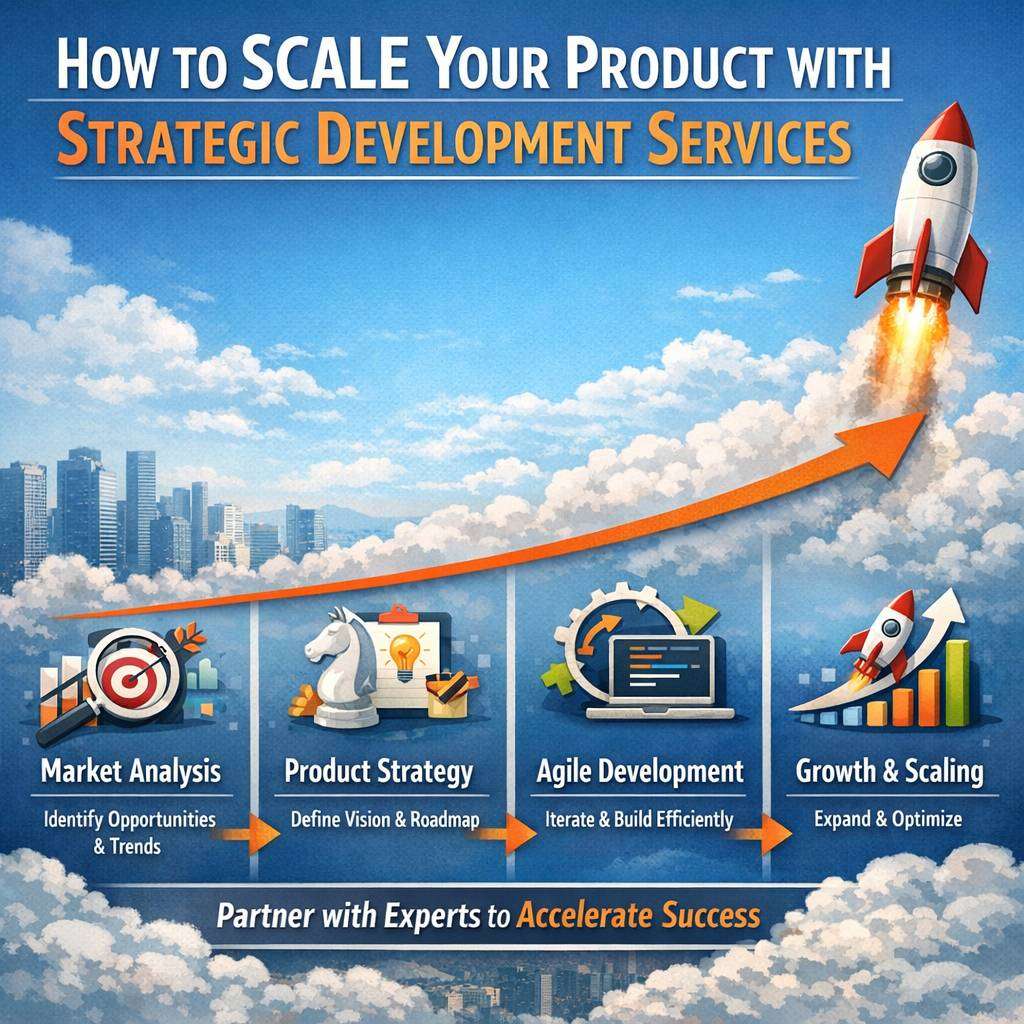
How to Scale Your Product with Strategic Development Services
New Product Development
In today’s fast-moving market, the ability to scale a product effectively hinges on a disciplined approach to development. New product development (NPD) is not a one-off sprint but a strategic programme that aligns market insight, technical feasibility, and business value. By adopting a structured NPD framework, organisations can accelerate time-to-value while managing risk. A robust NPD process typically includes ideation, feasibility analysis, rapid prototyping, user testing, and iterative refinement. When scaled properly, these stages become repeatable cycles that continuously unlock competitive advantage rather than a one-time push to market.
New Product Development Services
New product development services offer a bespoke set of capabilities designed to accelerate growth. Whether you are a startup seeking to validate a concept or an established firm aiming to extend a portfolio, these services provide access to specialised expertise, tools, and processes. The value lies not only in delivering a final product but in embedding strategic thinking across discovery, design, and delivery. When selecting new product development services, look for partners who can translate business goals into measurable product outcomes, deliver a clear roadmap, and maintain transparent governance throughout the engagement.
New Product Development Consultant
A new product development consultant can act as a guiding strategist and hands-on operator across the lifecycle of your product. The consultant’s role extends beyond managing timelines; they help you articulate a compelling value proposition, align stakeholders, and mitigate risk through rigorous assessment and prioritisation. A proficient consultant will balance user needs with technical viability and commercial plausibility, ensuring that every feature delivers real value. Engaging a new product development consultant early in the process can shorten discovery cycles, improve prioritisation, and establish governance that scales with your organisation.
Product development services drive innovation from concept to market, combining user research, rapid prototyping, and rigorous testing to ensure robust outcomes. Cross-functional collaboration accelerates timelines, reduces risk, and aligns technical feasibility with customer value. Teams leverage iterative feedback and data-driven decisions to refine features, benchmark competitors, and scale successfully. For more information, visit https://forward-npd.com/.
Product Development Consultant
A product development consultant brings cross-functional expertise to bear on complex challenges. Their remit often spans market research, product strategy, architecture decisions, and go-to-market planning. By acting as a bridge between business leaders and engineering teams, a product development consultant helps ensure that development efforts are not only technically sound but also aligned with strategic priorities. The right consultant will introduce scalable practices such as design for manufacturability, modular architecture, and continuous integration, creating a foundation for sustainable growth as you scale.
New Product Development Companies
New product development companies specialise in turning ideas into validated, scalable products. They combine market insight, engineering capability, and project governance under one umbrella, which can dramatically shorten the path from concept to commercialisation. When partnering with a new product development company, you can expect a holistic engagement from discovery through to market launch, with milestones, risk management, and performance metrics clearly defined. This integrated approach helps organisations avoid silos and ensures that development remains tightly aligned with strategic objectives.
NPD New Product Development
NPD new product development is the discipline of advancing ideas through a rigorous pipeline that yields viable market offerings. Within NPD, prioritisation frameworks, customer discovery, and phased testing are essential components. Organisations that invest in NPD as a deliberate capability tend to achieve faster iteration cycles, better product–market fit, and improved return on investment. A mature NPD practice also facilitates portfolio management, enabling you to balance parallel streams and allocate resources where the potential impact is greatest.
New Product Development Company
A new product development company can serve as a long-term partner for growth or a temporary accelerant during a strategic pivot. Such firms typically provide end‑to‑end services—from ideation workshops and concept validation to technical delivery and post‑launch optimisation. Working with a new product development company can unlock access to advisory talent, modern tooling, and established processes that help you scale with confidence. Choose a partner whose capabilities cover both the rigour of method and the flexibility required by a rapidly evolving market.
Development of New Products
The development of new products is a cross-disciplinary endeavour that requires governance, discipline, and a culture of experimentation. The development process should be designed to de-risk uncertain bets and to learn quickly from user feedback. Key activities include defining measurable success criteria, building MVPs (minimum viable products), conducting usability studies, and implementing scalable architecture. Successful development of new products hinges on an evidence-based approach: hypothesis-driven experiments, rapid prototyping, and disciplined decision-making informed by data.
Strategic Alignment and Roadmapping
Strategic alignment is the backbone of scalable growth. Before you embark on any development programme, ensure that your product strategy is explicitly linked to business objectives, user needs, and competitive context. A well-crafted strategy translates into a clear roadmap with phased milestones, resource plans, and budget guardrails. Strategic roadmapping helps prioritise initiatives with the highest potential impact and creates a shared reference point for executives, stakeholders, and delivery teams. When you partner with development services, insist on transparent prioritisation criteria and a living road map that adapts to market feedback and shifting priorities.
Discovery, Validation, and Prototyping
Successful scaling begins with discovery and validation. Engage in structured discovery sessions to uncover customer pains, jobs-to-be-done, and desired outcomes. Validation activities—such as concept testing, usability research, and technical feasibility assessments—help ensure ideas are sleep-tested before significant investment. Prototyping, including low-fidelity and high-fidelity iterations, enables rapid experimentation and learning. A disciplined prototyping approach keeps teams focused on user value while reducing the risk of feature bloat or misalignment with strategic aims.
Architecture, Engineering, and Delivery
As you scale, the technical backbone becomes critical. A scalable architecture—emphasising modularity, clear interfaces, and scalability—facilitates faster delivery cycles and easier adaptation to changing requirements. Engineering practices such as continuous integration, automated testing, and robust release management are essential. Delivery teams should work in close collaboration with product and design to maintain a coherent product vision while ensuring quality and reliability. An emphasis on maintainable code, clear documentation, and governance reduces long‑term costs and accelerates future development.
Go-to-Market and Growth Enablement
Scale is not only about building; it’s also about market execution. A comprehensive go-to-market (GTM) plan, informed by customer segments, pricing strategy, and distribution channels, is crucial. Growth enablement includes onboarding, customer success, and analytics that track product usage, retention, and monetisation. By embedding GTM considerations into development cycles, you ensure that products are not only technically sound but also positioned to capture and sustain market share.
Governance and Metrics
Clear governance and outcome-oriented metrics keep development aligned with strategy. Define leading indicators for discovery, delivery, and adoption, and establish cadence for reviews with stakeholders. Metrics should be actionable, contrasted with baselines, and tied to business impact such as revenue growth, cost-to-serve reductions, or time-to-market improvements. A data-informed culture helps you prioritise, optimise, and scale with confidence.
Cultivating a Partner Ecosystem
Finally, consider building a resilient partner ecosystem. Strategic development services thrive when complemented by expert consultancies, technology partners, and industry peers who can share insights, tools, and best practices. A well-chosen ecosystem accelerates learning, reduces risk, and expands capability beyond your internal constraints. Ensure that partners share your commitment to quality, transparency, and measurable outcomes.
If you are contemplating scale, engage early with a new product development consultant or a development partner who can offer both the strategic perspective and operational capability. The aim is to create a repeatable, data-driven pipeline that turns ideas into scalable products while maintaining a clear line of sight to value. Through disciplined NPD practices, rigorous validation, and robust delivery, you can realise substantial growth and long-term resilience in a competitive landscape.